
Glynn County packs very different teardown sites into one coastal county. There is the brick-and-frame housing stock of Brunswick, the county seat; the subdivisions and rural tracts of the unincorporated mainland; cottages and older homes on St. Simons Island; and the houses on Jekyll Island, where the state’s Jekyll Island Authority sets its own building rules. Who signs off on a demolition job depends on which of those places the parcel sits in, and on the islands the saltmarsh, the dunes and the trees can matter as much as the building. Arwood Disposal plans demolition and debris haul-off for owners, builders and property managers across the county. Trucks run up I-95 from our headquarters at 16144 Main St N, Jacksonville, FL 32218, and there is no Arwood office or yard in Glynn County. Ring (855) 713-6280 or write to [email protected] with the street address and a handful of photos. Call for a quote; every structure is priced on what is actually there.
First question: whose permit is it?
A Glynn County mailing address does not tell you which office issues the demolition permit. Brunswick is the only incorporated city, Jekyll Island is run by a state authority, and everything else, St. Simons and Sea Island included, is unincorporated county. Pull up the parcel on the county property search before anyone fills out a form.
Unincorporated mainland, St. Simons and Sea Island
Outside the city and off Jekyll, the permit comes from Glynn County Building Permitting and Inspections, 1725 Reynolds Street, Suite 200, in Brunswick (912-554-7456, [email protected]). Office hours run Monday through Friday, 8:00 to 4:00, and the phone line stays open until 4:30. The county’s list of work that needs a permit includes the removal or demolition of any building or structure, so a detached garage or a storm-damaged shed counts as well as a house. Applications go through the county’s OpenGov portal.
The county also asks for a signed asbestos acknowledgement with every demolition or renovation permit. On that form the applicant agrees that the permit is not permission to start tearing down until any required state filing with the Environmental Protection Division has been made and its ten-day clock has run. Inspections can be requested through the portal around the clock, or by phone during the week before 4:30, with the permit number in hand.
Inside the City of Brunswick
City parcels go to the Planning, Development & Codes Department at 601 Gloucester Street (912-279-2656), which accepts demolition permit applications online. Brunswick’s demolition application is unusually specific about what has to be attached before the building official will approve it:
- proof of ownership and the completed, signed application;
- written confirmation that the gas company, Georgia Power, the cable television company and the Brunswick-Glynn County Joint Water and Sewer Commission have been notified;
- for jobs that need the state filing, copies of the certified inspection report and of the state notification form, with the date it was mailed;
- for exempt houses, a notarized Demolition Exemption Affidavit, plus a second affidavit in which the applicant accepts responsibility for having the structure tested and for abating anything hazardous that turns up;
- a city right-of-way permit if one applies, and a Certificate of Appropriateness for property in the historic district.
The form also says that a complete structural demolition gets a final inspection only after the site has been cleared of all debris, and the applicant has to be there to meet the inspector. In practice that means the last roll-off has to leave before you can close out the permit, so we schedule the final haul with that inspection in mind.
Jekyll Island: the Authority, then the county
On Jekyll the Jekyll Island Authority issues its own building permits, and its code also calls for a Glynn County permit where one is required. Under the Authority’s ordinance, demolition is a Tier 3 permit, which means review by its Design Review Group, the same track as new houses and new commercial buildings. The Authority’s current building permit application lists demolition as a plan type, asks for a survey showing flood elevation and trees, and has the owner acknowledge Georgia 811 and keep construction work out of the right-of-way. Permit fees are paid at the Authority’s administration office at 100 James Road (912-635-4000). Allow time for that review before you book a demolition date.
Historic Old Town and the St. Simons village
Brunswick’s Old Town neighborhood was listed on the National Register of Historic Places as a historic district in April 1979, and the city created the Brunswick Historic Preservation Board by ordinance in 1999. Reviewing demolition of landmarks and existing buildings inside designated historic districts is one of the board’s stated jobs, and the city’s demolition checklist will not move forward without the board’s Certificate of Appropriateness when one applies. The board meets on the first Monday of each month at 6:00 in the evening at Old City Hall, 1229 Newcastle Street, and the applicant or a representative is expected to attend. If the house is in Old Town, add at least one board cycle to your timeline.
St. Simons has its own version of this. Glynn County legal notices show that taking down a house in the island’s village area can require a Village Preservation design review, heard in public by the Islands Planning Commission at the Historic Courthouse, 701 G Street in Brunswick. The commission handles planning matters for St. Simons, Sea Island and Little St. Simons, and county Planning and Zoning can tell you whether your lot is affected (912-554-7428, [email protected]).
The state filing that applies to most demolitions
Georgia’s Environmental Protection Division reads the word broadly. Its rules define demolition as wrecking or removing any load-supporting structural member, or intentionally burning a structure, and every such project is covered whether or not any asbestos is found. The filing must be in at least ten working days, Monday through Friday, before work begins. For paper filings the postmark is day one, and anything mailed on a Saturday or Sunday starts counting on Monday. The division also takes filings electronically through its GEOS online system.
Owners of residential buildings with four or fewer dwelling units are exempt, when the job is not tied to something bigger, such as a highway project, a commercial or industrial site, or urban renewal. Homes at one location that the same owner plans to remove at the same time are treated as one project. When a government agency has ordered a condemned building torn down, a copy of that condemnation order is attached to the filing. Where asbestos does turn up, the division requires the resulting debris to be handled as asbestos-containing material and buried at a permitted landfill. Brunswick’s affidavit adds a point worth remembering anywhere in the county: being exempt from the filing does not mean skipping the test.
Lines, meters and tanks
Georgia 811 lists demolition alongside excavation and grading as the kind of mechanized work its system covers. Submit a ticket online or by dialing 811 at least three business days before work begins, then check the utility responses online and confirm every member has marked or cleared before the machine moves. Locators mark their lines with colored paint by utility type.
For the service lines themselves, Brunswick’s checklist is a good model even outside the city: notify the gas provider, Georgia Power, the cable company and the Joint Water and Sewer Commission well ahead of the demolition date. Properties on septic should be discussed with Glynn County Environmental Health at 1725 Reynolds Street, Suite 200 (912-279-2940), before the tank is crushed or buried, since the office can tell you how an unused tank should be handled or whether a replacement home can use it.
Marsh lines, dunes and flood zones
Much of Glynn County is edged by tidal saltmarsh, and the islands face the open Atlantic. Georgia’s Coastal Marshlands Protection Act of 1970 and Shore Protection Act of 1979 cover activity in and next to those areas, and the Coastal Resources Division of the Department of Natural Resources says anyone planning to clear land or build near the marsh or the beach should get a current jurisdictional determination. Staff flag the vegetated upland boundary or the landward edge of the dune field on the property, the flags get surveyed onto the plat, and a determination is generally good for one year. Jekyll’s permit rules ask for those jurisdiction lines on the site plan. For a demolition job on a waterfront or oceanfront lot, settling where that line falls helps keep equipment, debris piles and the roll-off on the right side of it.
Flood maps shape many local rebuild-or-remove decisions. Glynn County takes part in the National Flood Insurance Program, requires a permit for any development in the floodplain, not only new buildings, and asks for an elevation certificate to issue a building permit there. When repairing or improving a floodplain building costs 50 percent or more of its market value, the building has to meet the same requirements as new construction. That rule is why some owners of older, low-lying houses choose to remove them and build new; the county Building Department can confirm the numbers for your property.
On Jekyll, trees get their own permit. The Authority bars removing a protected tree, cutting a limb more than two inches across on one, or disturbing a tree save area during construction without a permit from its tree inspector, who decides applications within ten working days. Removing a live oak over two inches in diameter calls for mitigation planting.
What we take down, and where it goes
The work we plan in Glynn County follows our demolition service: whole houses and outbuildings, commercial teardowns, emergency clean-up and excavation after storm damage, driveway and slab removal with the concrete sent to a recycler for crushing, partial or full swimming pool removal, and interior strip-outs for kitchens and baths. For mobile homes, keep in mind that the county notes that under Georgia law since 2006 only a licensed, registered installer may move and set up a mobile home; tell us whether yours is being hauled away whole or taken apart on site.
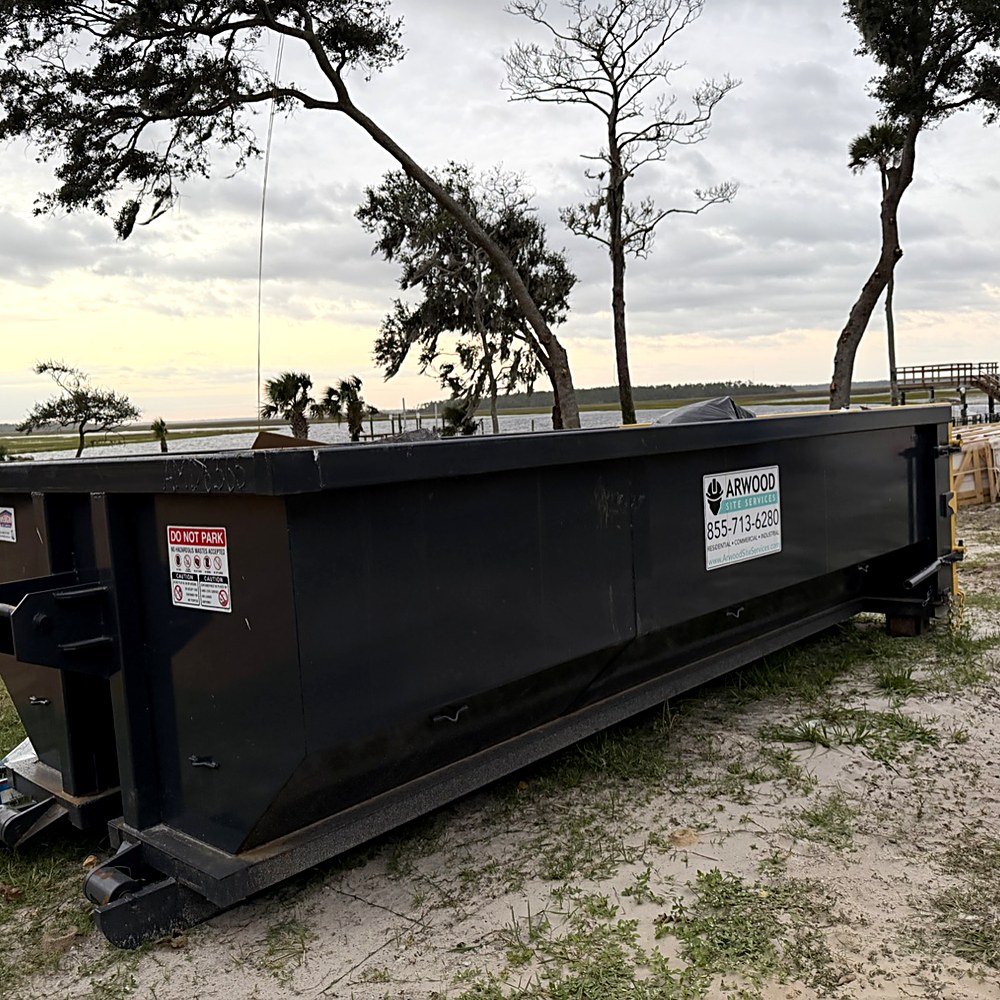
Plan the debris before the first wall comes down. Glynn County’s drop-off centers do take construction debris, but they are built for residents’ loads. The Young Lane and St. Simons sites charge by the load and keep weekday hours plus Saturday mornings, and the Habersham Street site charges by the ton and is open weekdays only. A whole house does not fit that pattern, so on most jobs a roll-off stays beside the work and is swapped as it fills, and we confirm acceptance with the receiving facility before each load leaves. Our Glynn County dumpster rental page covers placing a container on tight island lots, and paint, tires and hazardous materials are not taken at the county sites, so set those aside early. Do not burn the structure; under the state’s definition, setting a building on fire on purpose is itself a demolition.
Questions we hear from Glynn County owners
My house is on St. Simons. Do I go to the City of Brunswick?
No. St. Simons and Sea Island are unincorporated, so the permit comes from Glynn County Building Permitting and Inspections on Reynolds Street. Check with county Planning and Zoning as well if the lot is in the village area, because a Village Preservation review may come first.
Does a single-family house in Old Town need the state filing?
Usually not, if it has four or fewer units and is not part of a larger project. The city will still want both notarized affidavits and, in the historic district, a Certificate of Appropriateness from the preservation board before it issues the permit.
What changes for a house on Jekyll Island?
Demolition there goes through the Jekyll Island Authority’s Design Review Group first, with a survey showing flood elevation and trees, and any trees near the work fall under the Authority’s tree permit rules. A county permit may also be needed. Build that review into the schedule before booking equipment.
Is there an Arwood office in Brunswick?
No. Glynn County work is booked and sent out from our one headquarters on Main Street North in Jacksonville, down I-95 past the St. Marys River.
Get your Glynn County demolition on the calendar
Send the address or parcel number and tell us whether it is in Brunswick, the unincorporated mainland, St. Simons, Sea Island or Jekyll. Add photos of each structure, its approximate size, whether it ever had a commercial use, how it gets power, water and sewer, and how close it sits to the marsh or the dunes. We will map out which permits, notices and shutoffs come first and plan the haul-off around them. Our demolition contractor page describes the service, the demolition quote calculator gives a starting point, and the Contact page takes requests, as do (855) 713-6280 and [email protected]. Call for a quote before the permit is filed so the dates fit together. Arwood Disposal accepts orders from all 50 states, with coastal Georgia and Northeast Florida as everyday territory; see the Locations page for nearby areas, our home page for every service, and roll-off dumpster rentals if you only need a container.
Also for Glynn County: junk removal in Glynn County empties a house of furniture and appliances before the machines arrive, and portable toilet rental in Glynn County keeps a restroom on site for the crew.
Keep up with Arwood Disposal on Facebook or connect on LinkedIn.
Arwood Disposal, 16144 Main St N, Jacksonville, FL 32218 · (855) 713-6280 · [email protected]