
Taking a structure down in Baker County is rarely just a matter of bringing in a machine. A sagging single-wide on family acreage near Glen St. Mary, a storm-wrecked pole barn outside Sanderson, a 1950s block house on a Macclenny lot that is about to be replaced: each one has a permit desk, a state notice, buried lines and a pile of debris that all need to be sorted out before the first wall falls. Arwood Disposal plans demolition and debris haul-off for owners and builders across the county, and we handle the cleanup from the teardown through the last load. Jobs are scheduled from our headquarters at 16144 Main St N, Jacksonville, FL 32218; we do not have an office in Baker County. Phone (855) 713-6280 or email [email protected] with the address and a few photos. Call for a quote, since no two teardowns are alike.
The paperwork trail before anything comes down
Most of the delay on a demolition happens on paper, not on site. In Baker County three separate clocks start running once you decide to remove a building: the local building permit, the state’s asbestos notice and the utility locate. Starting all three in the same week keeps the machine from sitting idle.
Building permit: City of Macclenny or Baker County
Which office you deal with depends on the parcel. Inside the Macclenny city limits, the City of Macclenny Building Department states that permits are required to construct, enlarge, alter, demolish or change the occupancy of a building, and it asks every new contractor to register with the city before permitting can begin. Its permit line is 904-259-7529.
Everywhere else, start with the Baker County Building Department at 360 E. Shuey Avenue in Macclenny (904-259-2403), open weekdays from 8:30 a.m. to 5 p.m. The county will not let a state-certified contractor pull permits until the full set of credentials is on file: a current state license, liability insurance, workers’ compensation coverage or an exemption form, and an occupational license. If someone other than the license holder picks up the permit, the county wants an original, notarized authorization signed by the contractor. Its permit application also asks you to name the power company serving the property, which is a useful reminder that the electric disconnect is part of the job. Inspections are booked on a separate line, 904-259-4896, and a call placed by 4 p.m. gets you on the next business day’s schedule.
If your address says Glen St. Mary, Sanderson or Olustee, do not assume the mailing city tells you who issues the permit. Give the parcel number to the county building department and let it confirm which office has jurisdiction.
The asbestos notice that catches people off guard
The Florida Building Code, in a section Baker County includes with its permit documents, requires every demolition or renovation permit to carry an asbestos notification statement reminding the owner of the duty to notify the Department of Environmental Protection when the law applies. For demolitions, the state’s answer is broader than most people expect. DEP’s own guidance says that every demolition of a building meeting the federal definition of a facility needs a written notice, even when no asbestos is present at all.
Baker County falls under DEP’s Northeast District, reached at 904-256-1700. The notice goes in on DEP Form 62-257.900(1) or through the DEP Business Portal, and it must be postmarked or received at least 10 working days before the demolition starts. Working days run Monday through Friday, holidays included, and DEP says that waiting period is never shortened for a planned job.
A typical house is often outside that rule. DEP explains that an isolated residential building with four or fewer dwelling units is exempt, but only if it is not part of a larger project with several residential buildings, was never used for commercial purposes, and is not being torn down to make room for a commercial structure. Removing more than one small residential building on the same site, by the same owner or operator, puts the job back under the regulation. A former country store, a church fellowship hall or a building that once held a business are the kinds of Baker County structures where the notice is clearly required.
Call Sunshine 811 before the machine moves
Florida’s underground damage prevention law, Chapter 556, treats demolition the same way it treats digging. At least two full business days before demolition begins, the excavator has to give the free statewide notification system, Sunshine 811, the location, the dates and whether machinery will be used. The statute is blunt about demolition: work may not start in the noticed area until every member utility has marked and located its lines or removed them. A locate ticket is good for 30 calendar days, and the notification number has to be shown to a code inspector who asks for it. On a rural lot, buried power to a well pump or a barn is easy to forget, so walk the property and point those runs out.
Shutting off utilities on town lots and rural acreage
Under the Florida Building Code, the first demolition inspection is made only after every utility connection has been disconnected and secured so that nothing unsafe or unsanitary is left during or after the work. A final inspection follows once the demolition is complete. Plan the shutoffs early, because the utility’s schedule, not yours, sets the pace.
- Electric. Ask the provider that serves the meter to cut power and pull the service. Look for a separate meter at a barn, shop or well before you assume one call covers it.
- Gas. Have bottled-gas tanks removed by the supplier, and get any piped service shut off and capped at the street.
- Water and sewer. In town, contact whoever bills for water and sewer about closing the account and capping the lateral.
- Septic tank. Much of the county runs on septic. Onsite sewage permits here are handled by the Florida Department of Health in Baker County (904-259-6291) under DEP’s onsite sewage rules. When a system is being retired, Rule 62-6.011 lays out the sequence: an abandonment permit, pumping by a permitted septage disposal company, opening or collapsing the bottom of the tank so it cannot hold water, filling it with clean sand or other suitable material, covering it with soil, and an inspection. Ask the health department whether your tank must be abandoned or can serve the replacement home.
- Private well. A well that will not be reused cannot simply be left uncapped. Under Rule 62-532.400, a permit is needed before a water well is abandoned, and the application is filed by the owner or by a water well contractor for the owner. Baker County straddles two water management districts. For wells in the St. Johns River district, the county health department issues well permits under a delegation agreement, and the Suwannee River district covers the rest. Ask the health department which one applies to your parcel.
Teardowns we plan in Baker County
The work west of the Duval line tends to look different from city demolition. Lots are larger, structures are spread out, and an owner may want one building gone while another stays. Requests we help plan include:
- Old mobile homes. DEP says a mobile home used as a single-family dwelling is not subject to the federal asbestos rule unless it is part of a larger installation. A park owner clearing several units at once, or clearing them for a bigger project, is covered. Strip appliances and furniture first; our junk crews can take those before the frame is cut up.
- Barns, sheds and carports that storms or time have left leaning. Metal roofing, rotted posts and old wiring come out separately so the scrap and the wood can go where they belong.
- Block and frame houses on in-town lots being cleared for a new home, including breaking out the slab and footers when the new plan does not reuse them.
- Driveways, patios and sidewalks. As our service page describes, removed concrete can go to a recycler to be crushed into aggregate rather than buried.
- Swimming pools and interior gut-outs. An old pool can be partly removed and filled, or taken out entirely, and a kitchen or bath can be stripped to the studs ahead of a remodel.
Tell us about anything unusual when you call: a fuel tank, a shed full of paint cans, roofing that looks like old cement shingles, or a structure close to a property line. Those details shape the schedule and the paperwork.
Where the debris goes
The county’s staffed collection centers, run with the New River Solid Waste Association, are designed for household trash and small loads, and their posted rules ask residents to keep to about one cubic yard a week while steering larger and commercial loads to the regional landfill. A teardown can produce dozens of yards in an afternoon, so a collection center is not where a demolition ends up.
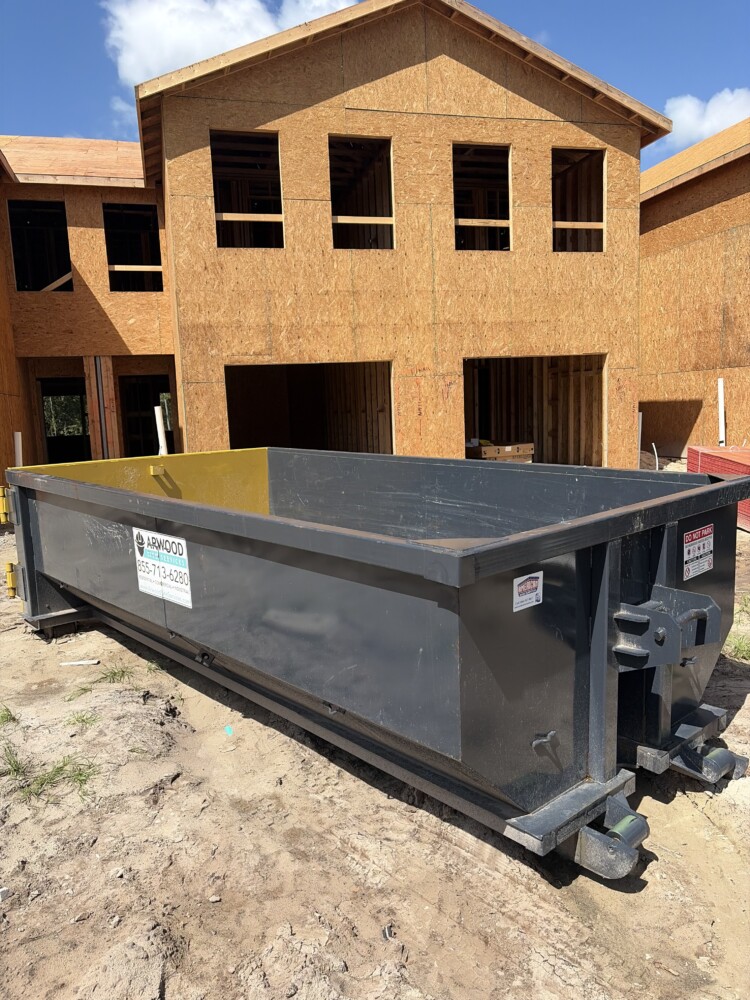
That regional site is the New River Regional Landfill at 24276 NE 157th Street in Raiford, just across the line in Union County. Baker, Bradford and Union counties formed the association in 1988 to share disposal costs, and the landfill was the state’s first multi-county regional facility. Acceptance rules for specific materials can change, so we confirm them with the landfill (386-431-1000) before a load goes out. On most jobs we set a roll-off beside the work area and swap it as it fills; our Baker County dumpster rental guide covers placement on sand drives and rural lots.
Burning the old building is not a shortcut. DEP lists roofing, tar, treated wood, plastics, asbestos-containing materials and trash among the things that may never be open burned in Florida, and local governments can set stricter limits. DEP also counts the intentional burning of a building as a demolition for asbestos purposes.
Baker County demolition questions
Do I need the DEP notice to tear down my own house near Glen St. Mary?
Usually not, if it is a single house with four or fewer units, was never used commercially, and is not one of several buildings coming down together or being cleared for a commercial building. The building permit will still include the asbestos statement, and if anything about the job is borderline, call the Northeast District before you set a date.
Can I just burn the old barn or house?
No. State rules ban open burning of roofing, treated wood, plastics and trash, which describes most of what a building is made of. Haul it instead; a roll-off on site makes that the easier route.
How far ahead should I start on an old single-wide in the county?
Start with the county building department, then book the utility shutoffs and the Sunshine 811 ticket so they are done before the crew arrives. If the septic tank or well will not be reused, add the health department to the list early, because those permits run on their own timeline.
Do you have an office or yard in Macclenny?
No. Every Baker County job is booked and dispatched from our Jacksonville headquarters on Main Street North, a short run west on I-10.
Plan your Baker County demolition
Send the street address or parcel number, photos of each structure, its rough size, whether it was ever used as a business, and how the property gets water, sewer and power. We will walk you through the order of permits and notices and plan the debris removal around them. Read more about what we take down on our demolition contractor page, try the demolition quote calculator, or reach us through the Contact page, at (855) 713-6280 or at [email protected]. Call for a quote before you file for the permit so the dates line up. We take orders in all 50 states, and Northeast Florida is home ground; the Locations page lists nearby areas, and the Arwood Disposal home page shows every service, including roll-off dumpster rentals.
More for Baker County: junk removal in Baker County clears furniture and appliances before a teardown, and portable toilet rental in Baker County covers restrooms for the crew while the site is rebuilt.
Follow Arwood Disposal on Facebook and LinkedIn.
Arwood Disposal headquarters: 16144 Main St N, Jacksonville, FL 32218 · Call (855) 713-6280 · [email protected]